Our group has determined the the metric in which we will use to compare the OECD and HIPC countries. We will track GDP per capita over time and study how certain factors correspond to the growth of GDP per Capita. The factors of study are isted below.
- education expenditure
- gross savings
- compensation for employees
- tax revenue % of GDP
- GDP Growth (Might not be neccessary given what we’re using to measure economic development)
- FDI
- Monetary Sector Credit to Private Sector as % of GDP
- Unemployment rate
This week we studied how these covariates relate to the rise of GDP per capita in HIPC across the world. Firstly we will study Monetary Sector Credit to Private Sector as % of GDP and how it relates to gdp per capita.
library(ggplot2)
data.in <- read.csv(file.choose())
head(data.in)
## MSC_70 FDI_70 GDP_70 X X.1 EE_70 Year_70 GDPPC
## 1 9.672431 0.9119564 1.49480e+11 NA NA 3.082898 1970 719.6410
## 2 10.092079 0.6469092 1.55825e+11 NA NA 3.269036 1971 730.6380
## 3 10.680662 0.7033483 1.58462e+11 NA NA 3.484333 1972 723.5575
## 4 11.255663 0.7616990 1.63032e+11 NA NA 3.479373 1973 724.8922
## 5 12.612460 0.7038800 1.72314e+11 NA NA 3.276370 1974 746.0455
## 6 13.973724 0.6303407 1.75802e+11 NA NA 3.470933 1975 741.1724plot(data.in$MSC_70, data.in$GDPPC)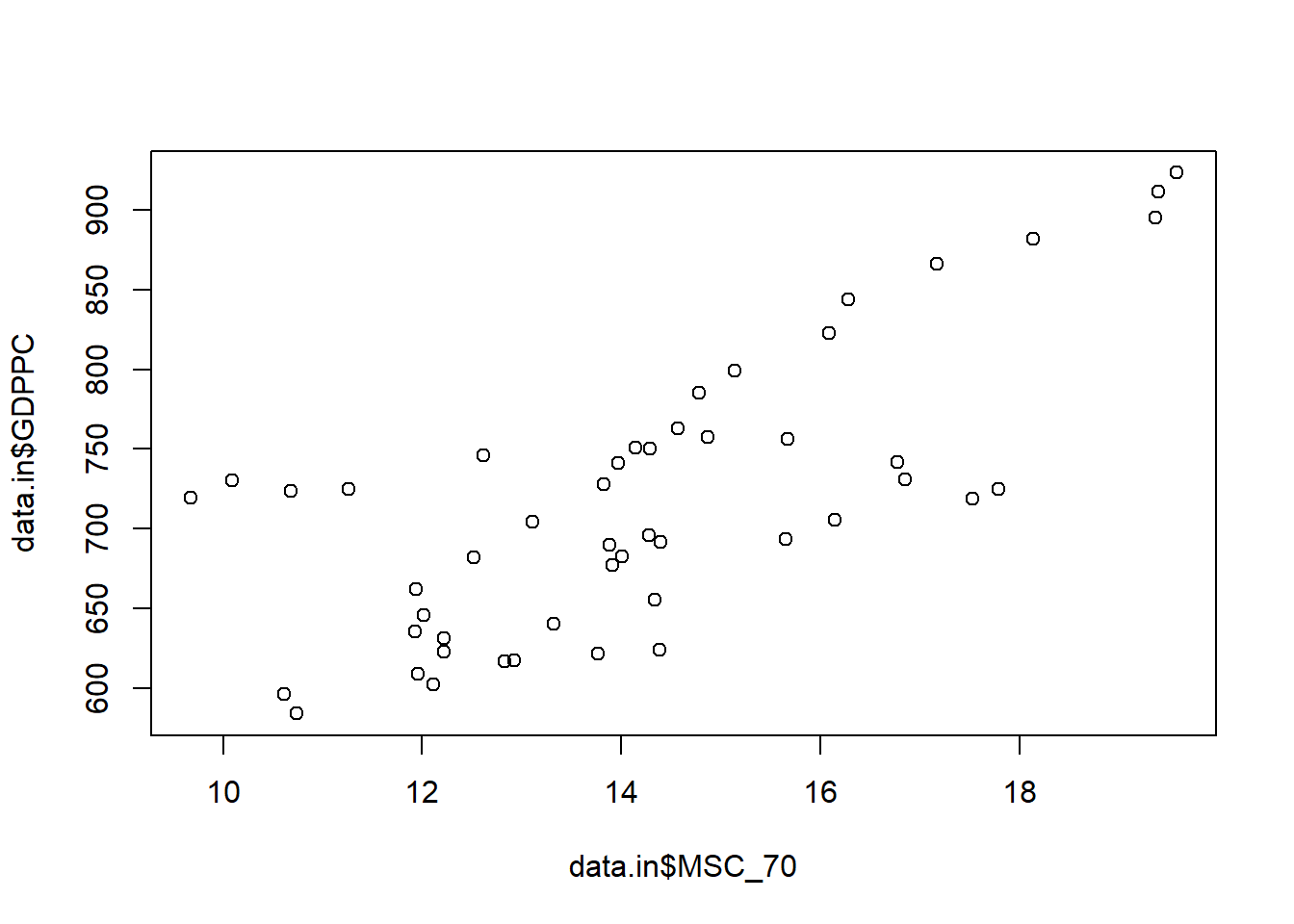
MSC <- lm(data.in$GDPPC ~ data.in$MSC_70)
summary(MSC)
##
## Call:
## lm(formula = data.in$GDPPC ~ data.in$MSC_70)
##
## Residuals:
## Min 1Q Median 3Q Max
## -97.37 -50.57 -15.54 53.83 118.06
##
## Coefficients:
## Estimate Std. Error t value Pr(>|t|)
## (Intercept) 356.192 50.105 7.109 5.59e-09 ***
## data.in$MSC_70 25.404 3.478 7.304 2.83e-09 ***
## ---
## Signif. codes: 0 '***' 0.001 '**' 0.01 '*' 0.05 '.' 0.1 ' ' 1
##
## Residual standard error: 59.19 on 47 degrees of freedom
## Multiple R-squared: 0.5316, Adjusted R-squared: 0.5217
## F-statistic: 53.35 on 1 and 47 DF, p-value: 2.833e-09equation1=function(x){coef(MSC)[2]*x+coef(MSC)[1]}
MSCp <- ggplot(data.in ,aes(y=GDPPC,x=MSC_70,color="blue"))+
geom_point()+
stat_function(fun=equation1,geom="line",color=scales::hue_pal()(2)[1]) +
xlab("MSC")+
ylab("GDP per Capita")+
ggtitle("How does MSC relate to GDP per Capita")
MSCp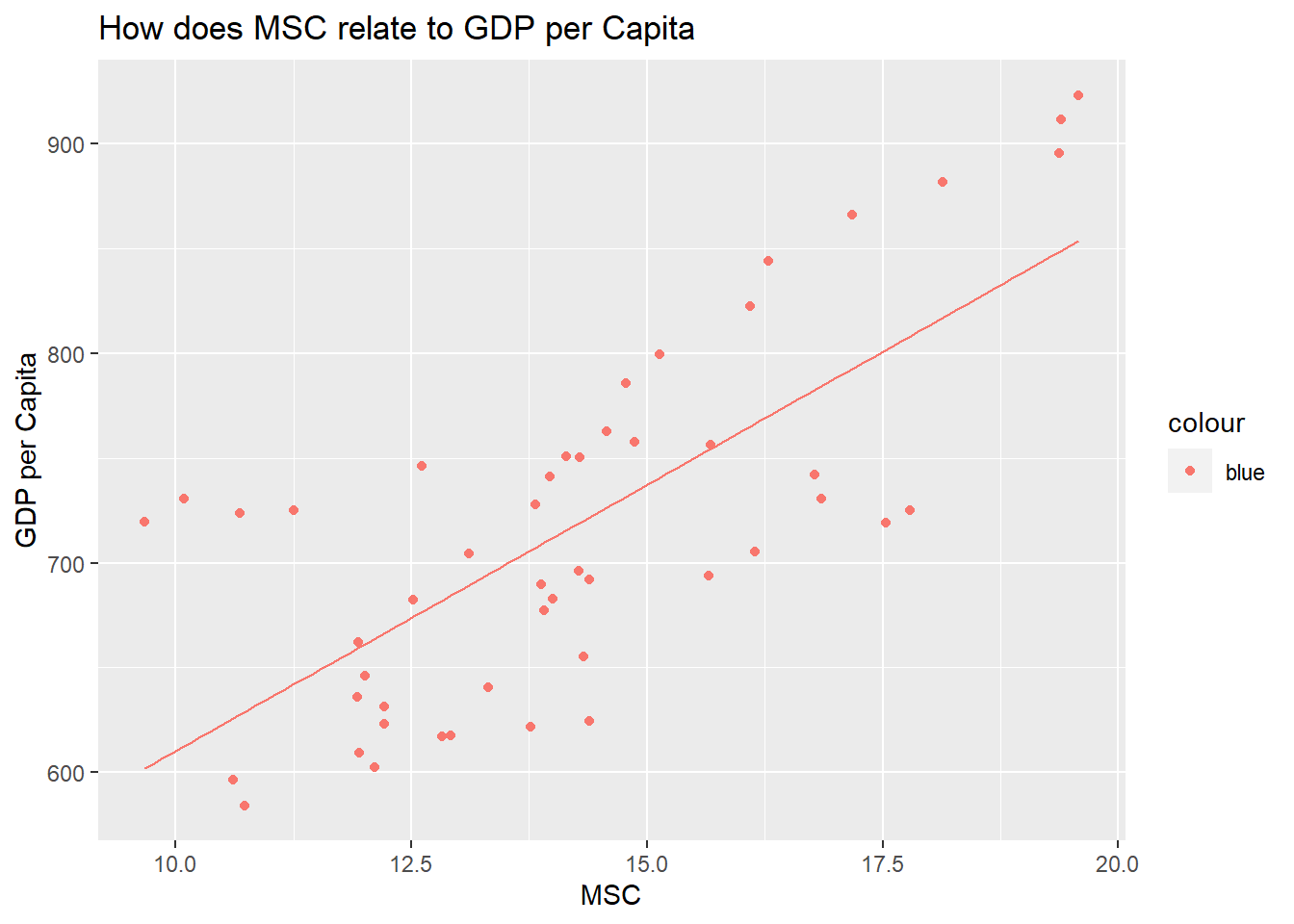
We should conclude from this model that MSC is related to the growth of a nation’s GDP percapita. In this case specifically, it is correlated to growth in HIPC countries. The actor’s coefficient is highly significant with a test statistic of 7.304 and has a corresponding p-value of <.00001.
We will repeat this process with another covariate for this blog post.
Next we will examine FDi
plot(data.in$FDI_70, data.in$GDPPC)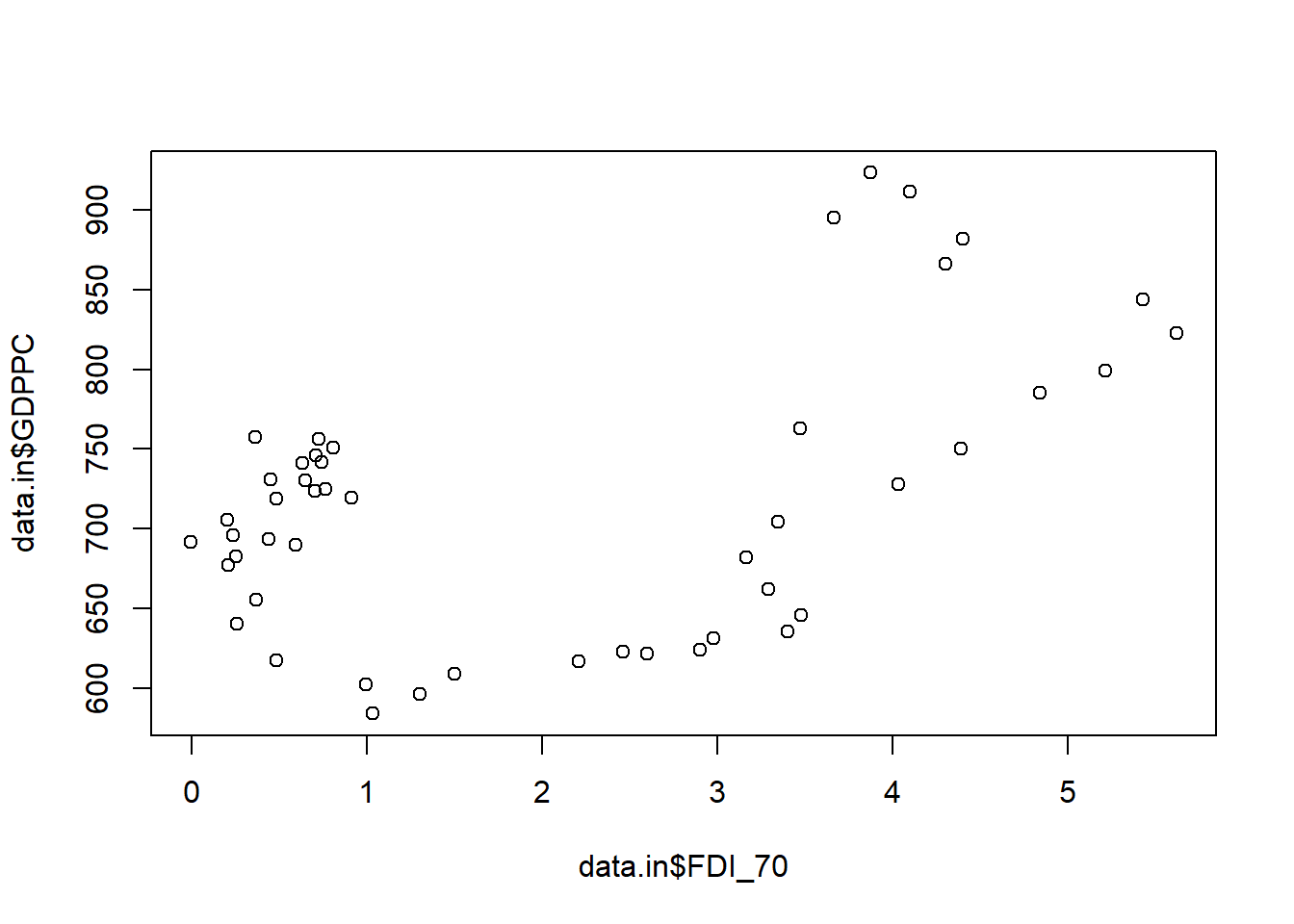
FDINORM <- lm(data.in$GDPPC ~ data.in$FDI_70)
summary(FDINORM)
##
## Call:
## lm(formula = data.in$GDPPC ~ data.in$FDI_70)
##
## Residuals:
## Min 1Q Median 3Q Max
## -113.34 -62.60 11.94 46.93 162.82
##
## Coefficients:
## Estimate Std. Error t value Pr(>|t|)
## (Intercept) 668.89 16.87 39.650 < 2e-16 ***
## data.in$FDI_70 23.61 6.35 3.719 0.000533 ***
## ---
## Signif. codes: 0 '***' 0.001 '**' 0.01 '*' 0.05 '.' 0.1 ' ' 1
##
## Residual standard error: 76.03 on 47 degrees of freedom
## Multiple R-squared: 0.2274, Adjusted R-squared: 0.2109
## F-statistic: 13.83 on 1 and 47 DF, p-value: 0.0005327sqrFDI <- (data.in$FDI_70)^2
FDI <- lm(data.in$GDPPC ~ data.in$FDI_70 + sqrFDI)
summary(FDI)##
## Call:
## lm(formula = data.in$GDPPC ~ data.in$FDI_70 + sqrFDI)
##
## Residuals:
## Min 1Q Median 3Q Max
## -94.08 -59.21 -19.49 42.77 180.69
##
## Coefficients:
## Estimate Std. Error t value Pr(>|t|)
## (Intercept) 713.532 20.780 34.337 < 2e-16 ***
## data.in$FDI_70 -49.132 23.434 -2.097 0.04156 *
## sqrFDI 14.628 4.565 3.204 0.00246 **
## ---
## Signif. codes: 0 '***' 0.001 '**' 0.01 '*' 0.05 '.' 0.1 ' ' 1
##
## Residual standard error: 69.49 on 46 degrees of freedom
## Multiple R-squared: 0.3683, Adjusted R-squared: 0.3409
## F-statistic: 13.41 on 2 and 46 DF, p-value: 2.578e-05data.in$pred.fdi <- predict.lm(FDI)
length(data.in$GDPPC)## [1] 49length(data.in$FDI_70)## [1] 49FDIp <- ggplot(data.in, aes(y=GDPPC,x=pred.fdi ,color="blue"))+
geom_point()+
geom_smooth(method = "lm", se = FALSE)+
xlab("FDI")+
ylab("GDP per Capita")+
ggtitle("How does FDI relate to GDP per Capita")
FDIp## `geom_smooth()` using formula 'y ~ x'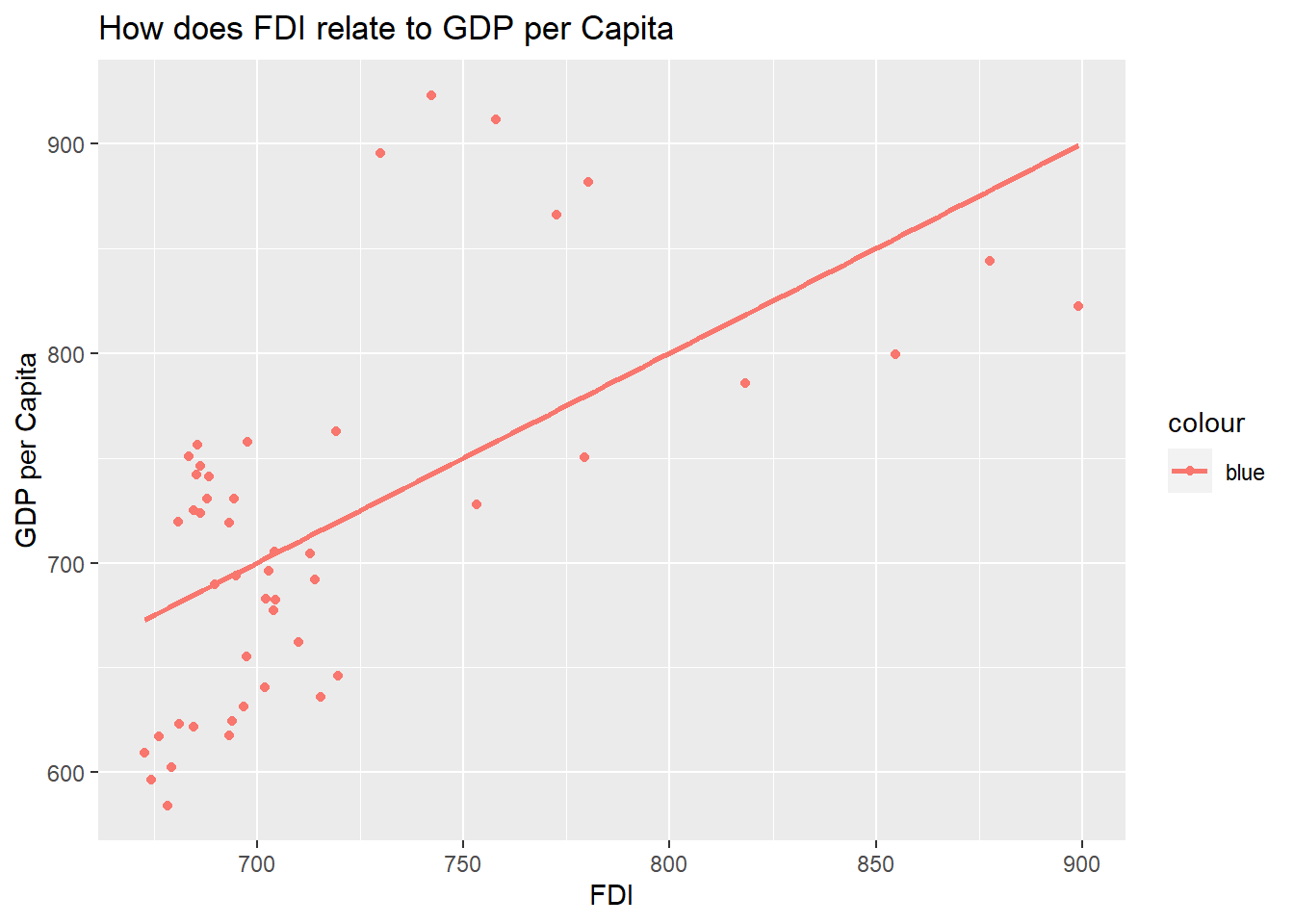 While the summary of the data is indicating that FDI has a positive linear relationship with GDP per Capita, I belive a linear trend may not be the most efficient at modeling the data’s relationship. In future analysis we will adjust and transfrom the data to fit a better model. We attempted to fit the model with a quadratic term however there still seems to be issues with the model fit with a high cluster in the lesser values of FDI.
We will continue with this data analysis to inform the creation of a multivariate linear model to predict GDP per Capita in HIPC countries. We will repeat the process for OECD countries and compare the relationships between these metrics and more developed nations.